
This post is about kurma murah borong, the Malay phrase for cheap dates bought wholesale, and how much sugar those dates carry compared with fresh fruit. In Malay, borong kurma on its own means dates bought wholesale; murah adds 'cheap'. The nutrient figures below come from USDA FoodData Central and the guidance on sugar comes from the NHS. For a separate read on one variety of dates, there is an older post on Kurma Majol on this site.
How much sugar is in a date
USDA FoodData Central's SR Legacy set has two records for plain dates, one per named variety. The Medjool record lists 66.5 g of total sugars per 100 g. The Deglet Noor record lists 63.4 g. Both records give 75.0 g of carbohydrate per 100 g, and both show the fruit is only about a fifth water: 21.3 g in the Medjool record, 20.5 g in the Deglet Noor one.
These are figures for the samples USDA analysed, last updated in 2019. They describe the varieties, not any particular pack sold in Malaysia, so treat them as a guide rather than a label.

Dates beside other fruit, 100 g for 100 g
Weight for weight, the gap with fresh fruit is wide. The table puts the two date records next to three other dried fruits and five fresh ones, all from the same USDA set.
| Food (USDA FDC record) | Energy (kcal) | Total sugars (g) | Fibre (g) | Water (g) |
|---|---|---|---|---|
| Dates, Medjool (168191) | 277 | 66.5 | 6.7 | 21.3 |
| Dates, Deglet Noor (171726) | 282 | 63.4 | 8.0 | 20.5 |
| Raisins, dark, seedless (168165) | 299 | 65.2 | 4.5 | 15.5 |
| Figs, dried (174665) | 249 | 47.9 | 9.8 | 30.0 |
| Prunes (168162) | 240 | 38.1 | 7.1 | 30.9 |
| Grapes, raw (174683) | 69 | 15.5 | 0.9 | 80.5 |
| Mango, raw (169910) | 60 | 13.7 | 1.6 | 83.5 |
| Banana, raw (173944) | 89 | 12.2 | 2.6 | 74.9 |
| Apple, raw, with skin (171688) | 52 | 10.4 | 2.4 | 85.6 |
| Orange, raw (169097) | 47 | 9.35 | 2.4 | 86.8 |
Among the dried fruits, raisins sit level with dates on sugar. Dried figs and prunes are lower. Every fresh fruit record in the table lists more than 70 g of water per 100 g, against 21.3 g and 20.5 g for the two dates. A 100 g comparison is not how either food is portioned, so the next section switches to portions.
Which sugars, and why the two varieties differ
The two date records do not split their sugar the same way. In the Medjool record, almost all of it is glucose and fructose. In the Deglet Noor record, sucrose is the largest single sugar.
| Per 100 g | Glucose (g) | Fructose (g) | Sucrose (g) |
|---|---|---|---|
| Medjool (168191) | 33.7 | 32.0 | 0.53 |
| Deglet Noor (171726) | 19.9 | 19.6 | 23.8 |
| Mango (169910) | 2.01 | 4.68 | 6.97 |
| Apple (171688) | 2.43 | 5.9 | 2.07 |
So "dates are mostly fructose and glucose" is true of the Medjool sample and only partly true of the Deglet Noor one. Medjool originated in Morocco. Deglet Noor, sold in Malaysia on the stem as kurma tangkai, comes from Tunisia and Algeria. Two dates, two different sugar profiles.
A fairer comparison: one portion each
The NHS counts "30g of dried fruit (this is equivalent to around 80g of fresh fruit)" as one portion of your 5 A Day, and its list of examples names dates. Putting each food at its portion size gives a more useful picture. The sugar figures below are the USDA values scaled to 30 g or 80 g.
| Portion | Total sugars (g) |
|---|---|
| 30 g Medjool dates | 20.0 |
| 30 g raisins | 19.6 |
| 30 g Deglet Noor dates | 19.0 |
| 30 g dried figs | 14.4 |
| 30 g prunes | 11.4 |
| 80 g grapes | 12.4 |
| 80 g mango | 11.0 |
| 80 g banana | 9.8 |
| 80 g apple | 8.3 |
| 80 g orange | 7.5 |
Even at portion size, a serving of dates carries more than twice the sugar of a portion of apple. That is the plain arithmetic of the USDA numbers, and it is worth knowing before you put a bowl of dates on the counter.
Free sugars, teeth and where dates fit
The NHS separates "free sugars" from the sugar inside whole fruit. Its page on sugar says: "Sugar found naturally in milk, fruit and vegetables does not count as free sugars." It adds that "sugar in fruit is not considered free sugars unless the fruit is juiced or puréed." By that wording, a whole date is not a free-sugar food, while a date purée is puréed fruit. Adults, the same page says, "should have no more than 30g of free sugars a day."
Teeth are a separate point. The NHS portion-size page says "dried fruit can be high in sugar and can be bad for your teeth," and the 5 A Day page says dried fruit "should be eaten at mealtimes, not as a between-meal snack, to reduce the risk of tooth decay." So the NHS line is not "avoid dates". It is: count 30 g as a portion, and have it with a meal.
What the glycaemic index studies measured
The original version of this post said dates have a moderate GI. The studies are more specific than that. A 2016 trial at Qassim University in Saudi Arabia (PMID 27920411) tested 17 date varieties at the tamer stage on 19 healthy adults. The mean GI was 55.2, with a range from 42.8 to 74.6. Sukkary scored 43.4 and Sellaj 74.6, yet the authors found "no significant difference in GI between the date varieties." Glycaemic load (GL) values did differ significantly, from 8.5 to 24.
A 2011 study (PMID 21619670) tested five varieties in 13 healthy volunteers and recorded GIs from 46.3 to 55.1, which the authors described as low. Neither study tested the exact fruit in any Malaysian pack, so the honest summary is narrow: in these two trials, the tested dates gave GI values between about 43 and 75.
What cheap wholesale dates cost per kilo and per portion
Now the price side. On one Malaysian wholesaler's price list for borong kurma (wholesale dates), checked in November 2026, every date listing priced below RM15 a kilo was out of stock. The cheapest listings you could actually order are below. The last column divides the pack price by the number of 30 g portions in the pack; it is computed, not a listed price.
| In-stock listing | Pack | Price (RM) | RM per kg | RM per 30 g (computed) |
|---|---|---|---|---|
| Mariami A Normal | 5kg | 75 | 15.00 | 0.45 |
| Safawi Premium A No.2 (Mini) | 5kg | 80 | 16.00 | 0.48 |
| Deglet Noor Bertangkai 12 × 400g | 4.8kg | 88 | 18.33 | 0.55 |
| Safawi Premium A No.1 (Small) | 5kg | 95 | 19.00 | 0.57 |
| Rotab Sukkary Premium | 3kg | 63 | 21.00 | 0.63 |
| Ajwa Premium A No.1 (Small) | 5kg | 115 | 23.00 | 0.69 |
These six are every in-stock date listing on that list at RM23 a kilo or less. Mariami is an Iranian date, Safawi and Ajwa come from the Madinah region, and the Deglet Noor pack is the Tunisian and Algerian variety sold on the stem. Grade moves the price a long way: the same list had Safawi 5kg packs in stock from RM80 up to RM195.
Bulk buying changes the price per kilo, not the sugar per portion. A 5kg pack at RM75 is still 30 g portions of the same fruit. If you buy dates wholesale for a shop or for buka puasa, the NHS portion of 30 g at a meal is a simple way to plan how far a pack goes: a 5kg pack holds 166 full portions.
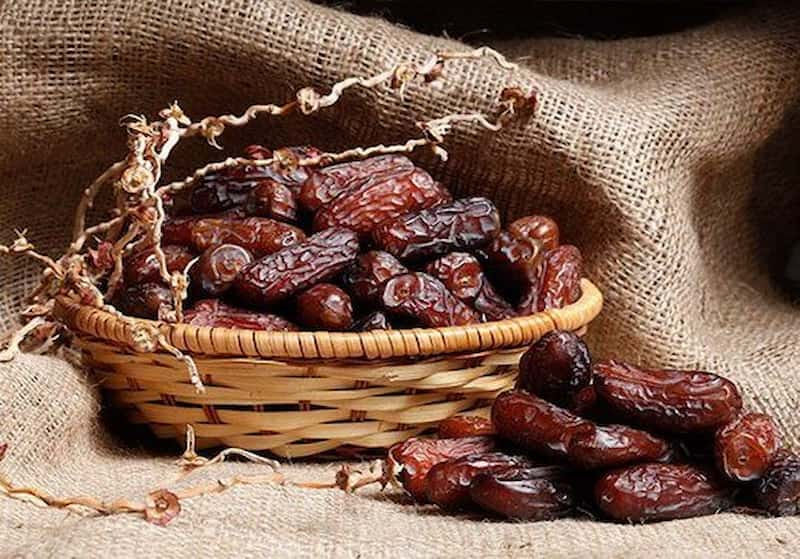
If you are weighing up wholesale buying in general, this site's post on buying kurma murah borong covers the purchasing side, and a Malay guide, Harga & Borong Kurma Medjool Palestin, looks at buying Medjool in bulk.
Quick answers
Do dates have more sugar than fresh fruit?
Per 100 g, yes, by a wide margin: 66.5 g in the USDA Medjool record against 10.4 g in raw apple. Per NHS portion, 30 g of Medjool dates has about 20 g of sugar, against about 8 g in 80 g of apple.
Does the sugar in whole dates count as free sugar?
Not under the NHS definition, which excludes sugar found naturally in fruit unless the fruit is juiced or puréed. The NHS still advises eating dried fruit at mealtimes for the sake of your teeth.
Is a cheaper date lower in sugar?
Nothing on a price list tells you that. The two USDA SR Legacy date records, Medjool and Deglet Noor, are close on total sugar (66.5 g and 63.4 g per 100 g).
More about this site is on the About Us page and the contact page.